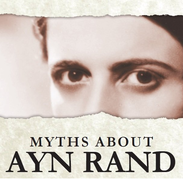
Many critics of Ayn Rand have a maddening tendency to take her to task for ideas she did not defend and in fact explicitly rejected. They would rather score cheap debating points, it seems, than actually think about her challenging vision of the possibilities of human life. Disagree with her all you want, but as Laurie Rice puts it in the introduction to Myths about Ayn Rand: Popular Errors and the Insights They Conceal, "If you value your argument, you do it a disservice by misrepresenting its opponent."
This slim volume of essays, published by the folks at The Atlas Society (for whom I have written) does a good job of dispelling some of the disinformation you may have come across regarding the author of The Fountainhead and Atlas Shrugged. And when the Kindle edition is available for a buck and can be read through in one sitting, critics have no excuse for getting it wrong.
David Kelly kicks things off by showing that Rand was not an elitist. Yes, the heroes of her novels are high achievers, which is what makes them so inspiring, but she explicitly rejected the notion that such people were morally superior to others and should rule over the rest of humanity. On her vision, Kelly writes, "It isn't for the privileged, but for the productive. It isn't against the poor, but against the irrational, the slothful, the envious, and the power-seeking—whatever their origin or social status."
Will Thomas takes the baton for myths two to five, explaining why Rand was not a conservative, was not for dog-eat-dog selfishness, and was not simply pro-wealthy or pro-business, and arguing also that she was indeed a serious philosopher. On this last point, Thomas tells us that although she was not an academic scholar, her views have come to have some influence on academic philosophy, especially in the realms of ethics and political philosophy, but also increasingly in epistemology as well.
Yet her philosophy, in very non-elitist fashion, has admittedly had more influence on ordinary people, and indeed, Rand argued persuasively that philosophy is for everyone, that it is something we all need. As Thomas writes, her novels are not just popular because of their entertainment value—though they are entertaining, despite another widespread myth not explicitly addressed in this collection. "When people read Rand, they are inspired, and challenged, and made to rethink what they've been taught. That's because Rand offers them timeless and compelling ideas about human life and the world we live in. It's her philosophy that keeps readers coming back."
In the postscript, Alexander Cohen takes up this theme in an open response to President Obama's implication, during the 2012 election campaign, that Rand is for teenagers. Cohen writes, "If you're the sort of teenager who wants an uplifting moral vision, a vision of joy and achievement rather than suffering and sacrifice […] then Ayn Rand is for you." But if you didn't happen to discover her as a teen, and if you're the sort of adult who also wants to be uplifted and inspired, then Ayn Rand just might be for you, too.
David Kelly kicks things off by showing that Rand was not an elitist. Yes, the heroes of her novels are high achievers, which is what makes them so inspiring, but she explicitly rejected the notion that such people were morally superior to others and should rule over the rest of humanity. On her vision, Kelly writes, "It isn't for the privileged, but for the productive. It isn't against the poor, but against the irrational, the slothful, the envious, and the power-seeking—whatever their origin or social status."
Will Thomas takes the baton for myths two to five, explaining why Rand was not a conservative, was not for dog-eat-dog selfishness, and was not simply pro-wealthy or pro-business, and arguing also that she was indeed a serious philosopher. On this last point, Thomas tells us that although she was not an academic scholar, her views have come to have some influence on academic philosophy, especially in the realms of ethics and political philosophy, but also increasingly in epistemology as well.
Yet her philosophy, in very non-elitist fashion, has admittedly had more influence on ordinary people, and indeed, Rand argued persuasively that philosophy is for everyone, that it is something we all need. As Thomas writes, her novels are not just popular because of their entertainment value—though they are entertaining, despite another widespread myth not explicitly addressed in this collection. "When people read Rand, they are inspired, and challenged, and made to rethink what they've been taught. That's because Rand offers them timeless and compelling ideas about human life and the world we live in. It's her philosophy that keeps readers coming back."
In the postscript, Alexander Cohen takes up this theme in an open response to President Obama's implication, during the 2012 election campaign, that Rand is for teenagers. Cohen writes, "If you're the sort of teenager who wants an uplifting moral vision, a vision of joy and achievement rather than suffering and sacrifice […] then Ayn Rand is for you." But if you didn't happen to discover her as a teen, and if you're the sort of adult who also wants to be uplifted and inspired, then Ayn Rand just might be for you, too.